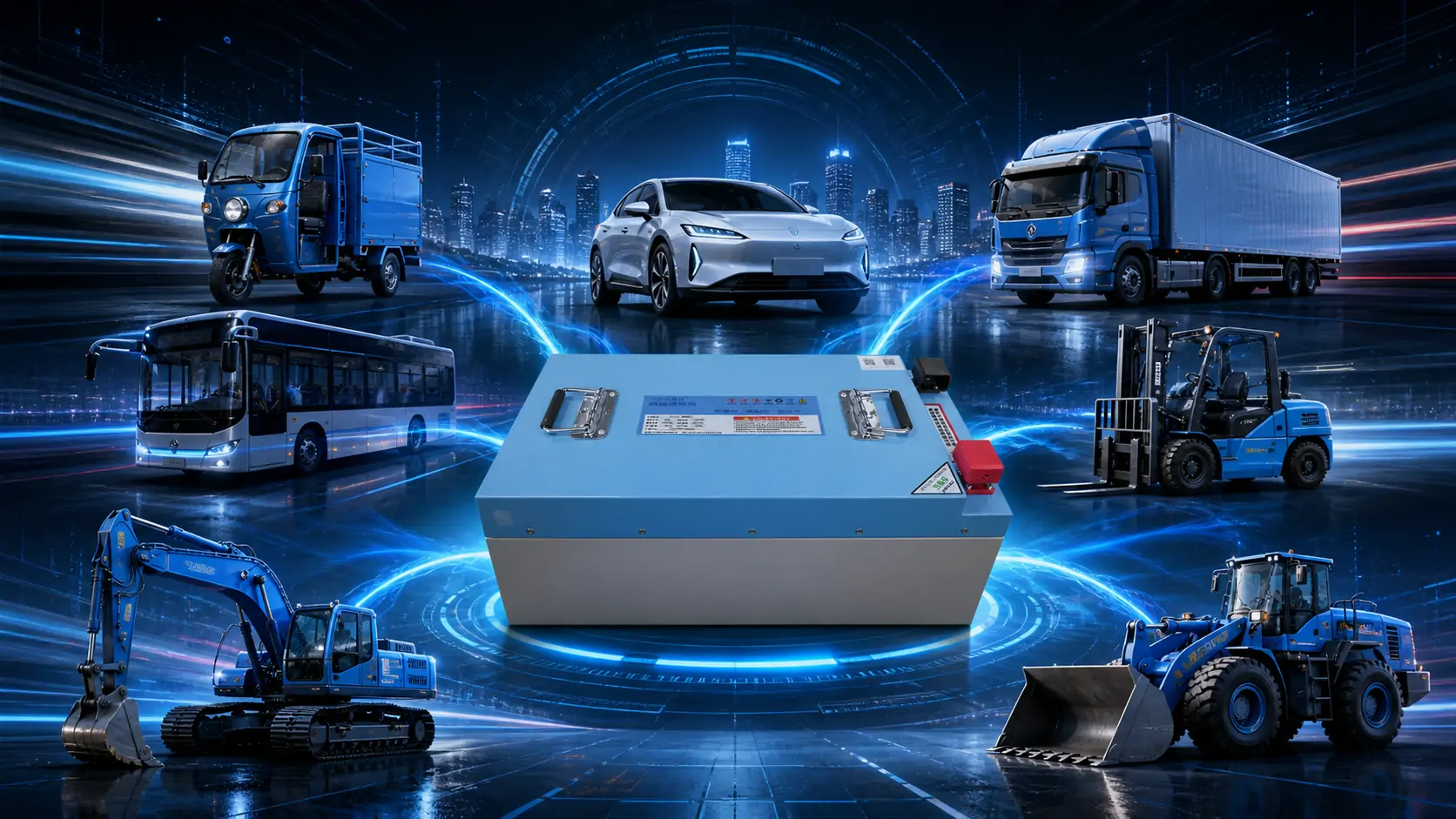
A Battery Management System (BMS) is a critical component in any LiFePO4 traction battery. It monitors cell voltages, temperatures, and current to ensure safe operation and maximize cycle life. For OEM and wholesale buyers, understanding BMS basics is essential for selecting the right battery configuration and avoiding common pitfalls.
What Does a LiFePO4 BMS Do?
The primary functions of a LiFePO4 BMS include:
- Cell balancing – Equalizes voltage differences between cells to prevent overcharge or undercharge of individual cells.
- Over-voltage protection – Disconnects the battery if any cell exceeds its maximum safe voltage (typically 3.65V for LiFePO4).
- Under-voltage protection – Prevents deep discharge by cutting off load when cell voltage drops below 2.5V.
- Over-current protection – Limits current to safe levels, protecting cells and wiring from damage.
- Short-circuit protection – Rapidly disconnects the battery in case of a short circuit.
- Temperature monitoring – Disables charging or discharging if cell temperature exceeds safe limits (usually 0°C to 60°C for charging, -20°C to 60°C for discharging).
Key Specifications for Traction Battery BMS
When sourcing a LiFePO4 BMS for traction applications, consider these parameters:
- Continuous discharge current – Must match or exceed the motor controller’s peak current draw. Common ratings range from 30A to 200A for traction batteries.
- Number of cells in series – Determines nominal voltage (e.g., 4S for 12.8V, 8S for 25.6V, 16S for 51.2V).
- Balancing current – Typically 50mA to 200mA; higher values improve balancing speed in large packs.
- Communication protocol – Some BMS units offer CAN bus, RS485, or Bluetooth for monitoring and diagnostics.
- Low temperature cutoff – Essential for cold climates; prevents charging below 0°C to avoid lithium plating.
BMS and Charger Compatibility
Not all chargers work with every BMS. The BMS must be matched to the charger’s voltage and current profile. For LiFePO4, the charger should have a constant current / constant voltage (CC/CV) profile with an absorption voltage around 3.6V per cell. The BMS will terminate charging if any cell reaches 3.65V, so the charger must not exceed this voltage. Always verify that the BMS and charger are from compatible manufacturers or specify a matched set when ordering.
Safety Considerations
A properly configured LiFePO4 BMS significantly reduces fire and failure risks. However, no BMS can compensate for poor cell quality or incorrect wiring. Always use matched cells from a reputable supplier, and ensure all connections are tight and properly insulated. For traction batteries, consider a BMS with redundant temperature sensors and a manual reset function for added safety.
Procurement Checklist for OEM and Wholesale Buyers
When evaluating BMS options for your LiFePO4 traction battery project, ask these questions:
- What is the maximum continuous and peak current rating?
- Does the BMS support active or passive balancing? What is the balancing current?
- What communication interface is available for monitoring?
- Is there a low-temperature charge cutoff? What is the threshold?
- What certifications does the BMS hold (e.g., CE, RoHS, UL)?
- Can the BMS be integrated with your existing battery management software?
Frequently Asked Questions
Can I use a generic BMS for any LiFePO4 battery?
No. A BMS must be selected based on the number of cells in series, the expected current draw, and the operating environment. Using an incorrect BMS can lead to overcharging, undercharging, or thermal runaway. Always match the BMS to your specific battery configuration.
What is the difference between active and passive balancing?
Passive balancing dissipates excess energy from higher-voltage cells as heat, while active balancing transfers energy from higher-voltage cells to lower-voltage cells. Active balancing is more efficient and faster, but also more expensive. For most traction batteries, passive balancing with a current of 100mA or more is sufficient.
How do I know if my BMS is working correctly?
Monitor cell voltages during charging and discharging using a BMS with a communication interface. All cells should stay within 0.05V of each other under normal operation. If you see large voltage differences or the BMS frequently disconnects, check for faulty cells or loose connections.
Does a BMS protect against all battery failures?
No. A BMS protects against electrical faults but cannot prevent mechanical damage, manufacturing defects, or improper installation. Regular inspection and proper handling are still required. Always source cells and BMS from reputable suppliers to minimize risks.
Leave a Reply